
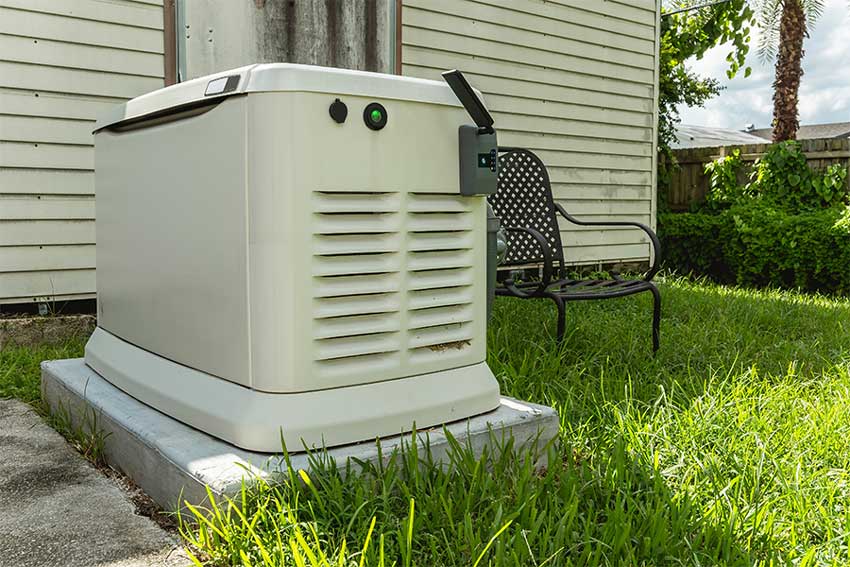
Generator sizing is where most standby power projects succeed or fail. Homeowners tend to approach the decision by looking at a range of available units and picking one that seems reasonable for a house their size. That approach produces two predictable outcomes: a system that cannot carry the home during an outage, or a system that costs considerably more than the household needs.
In our service calls throughout Lincoln, we see the consequences of both. Outages here are not rare events. Heavy tree cover along Great Road and through the neighborhoods surrounding Lincoln Woods means that nor’easters, ice storms, and late-summer tropical systems regularly take down service, sometimes for days. A generator that was sized on a guess becomes obvious the first time the household actually depends on it.
This guide covers what determines correct generator sizing, the specific loads that drive the calculation, and the practical decisions Lincoln homeowners face when planning a standby system.
Our electrical services in Lincoln, RI include load assessment, generator sizing, and complete standby system installation for homeowners who want the system matched to the home rather than to a general estimate.
Why Sizing Errors Cost More Than People Expect
An undersized generator does not simply run out of capacity gracefully. When demand exceeds what the unit can produce, voltage drops, the generator strains, and the system either sheds load unpredictably or shuts down entirely. The failure typically happens at the worst moment, when heat, well pumps, and refrigeration are all calling for power during a winter storm. Sustained operation in an overloaded condition also damages both the generator and the appliances connected to it.
Oversizing carries a different set of problems, and it is the error homeowners are more often talked into. A generator running well below its rated capacity does not reach proper operating temperature, which leads to incomplete combustion, carbon buildup on internal components, and accelerated wear. This condition, known as wet stacking in diesel and some propane units, shortens service life on equipment that should last decades. The larger unit also consumes more fuel, costs more to install, and requires a larger footprint on the property.
Correct sizing sits between those outcomes, and finding it requires an actual load assessment rather than a rule of thumb based on square footage.
Deciding What the Generator Actually Needs to Power
The first decision is scope, and it has a larger effect on cost than any other factor. There are three general approaches, and the right one depends on how the household uses power and what the family needs during an extended outage.
Essential circuits coverage powers a defined set of critical loads: heating, refrigeration, well pump, sump pump, a few lighting circuits, and outlets for medical equipment or communications. This is the most economical option and covers the functions that protect the home and its occupants.
Managed whole-home coverage powers the entire house but uses load management technology to shed non-essential circuits when demand peaks. This allows a smaller generator to serve a larger home by preventing simultaneous operation of the highest-draw equipment. For many Lincoln households, this is the practical middle ground.
Full whole-home coverage powers everything simultaneously with no load management. It requires the largest unit and the highest investment, and it makes sense for homes with substantial electrical demands or households that want the outage to be functionally invisible.
Our whole home generator installation work begins with this conversation, because a household that decides on managed coverage rather than full coverage often reduces the required generator size significantly without giving up anything they actually care about during an outage.
The Loads That Drive the Calculation
Sizing comes down to two numbers for every piece of equipment: what it draws while running, and what it draws during the moment it starts. Motor-driven equipment pulls a surge of current at startup that can be several times its running draw, and a generator has to have the headroom to absorb those surges without dropping voltage.
That distinction is why square footage is a poor sizing guide. A modest home with a deep well pump, a heat pump, and a septic pump can have higher peak demand than a much larger home on municipal water with gas heat.
The loads that most influence generator sizing in this area:
- Well pumps: Common throughout Lincoln’s less densely developed areas, and among the highest starting loads in any home
- Heating equipment: Furnace blowers, boiler circulators, and heat pumps, with heat pumps drawing substantially more than a gas furnace blower alone
- Central air conditioning: Compressor startup is typically the single largest surge load in a residential system
- Sump pumps: Critical during the same storms that cause outages, which makes them a non-negotiable load in most Lincoln basements
- Water heaters: Electric models represent a large continuous load, while gas models require only ignition and control power
- Kitchen appliances: Electric ranges and ovens draw heavily, and refrigeration is usually treated as essential
- EV charging: An increasingly common load that can rival everything else in the home combined, and one that is almost always managed or excluded
A professional load calculation accounts for the running draw of everything included in the coverage plan, the starting draw of the motor loads, and the realistic likelihood of simultaneous operation. That last factor is where experience matters, since a calculation that assumes every appliance runs at once produces a wildly oversized recommendation.
Fuel Supply Shapes What Is Practical
Fuel availability constrains the sizing conversation in ways homeowners do not always anticipate. Standby generators in this region typically run on natural gas or propane, and the choice affects both what is possible and what it costs to operate.
Natural gas is the simpler option where the service line reaches the property, since the supply is continuous and requires no storage or refills. The limitation is line capacity. A large generator has a substantial gas demand, and the existing service to a home is not always sized to support it alongside the furnace, water heater, range, and dryer. This needs to be verified before a unit is selected, not after.
Propane offers flexibility for properties without gas service, which includes a fair number of homes in the more rural sections of Lincoln toward Limerock and the Albion area. The tradeoff is storage. Tank capacity determines runtime, and a larger generator consumes propane faster, so the sizing decision and the tank sizing decision are directly connected. A household planning for multi-day outages needs both calculated together.
How Your Existing Panel Affects the Project
A generator does not connect to a home in isolation. It ties in through an automatic transfer switch, and that equipment has to integrate with the existing electrical service. The condition and capacity of the panel frequently determine what the installation actually involves.
Older panels present several common obstacles. A panel that is already full has no room for the circuits a transfer switch arrangement requires. A service undersized for current household demand cannot support the coverage the homeowner wants. Panels with known defects or deteriorated components are not a suitable foundation for a standby system, since the generator will be feeding power through equipment that was already marginal.
An electrical panel repair and upgrade is sometimes part of a generator project for exactly this reason. Addressing the panel first also creates an opportunity to organize circuits deliberately, grouping the loads intended for backup power so that the transfer switch arrangement is clean and the load management strategy works as designed.
Planning for the Life of the System
Sizing decisions have consequences that extend well past installation day. A properly sized unit that operates within its intended range runs efficiently, reaches correct operating temperature during exercise cycles, and delivers the service life the manufacturer designed it for. A unit operating consistently at the edge of its capacity, or far below it, will need attention sooner.
Based on what we see in Lincoln properties, the generators that give homeowners trouble are rarely failing because of a defect. They are failing because they were sized without a real load calculation, because household demand grew after installation, or because they were never exercised and maintained on a regular schedule. Standby equipment sits idle for months at a time, and equipment that sits idle needs deliberate upkeep to be ready when it matters.
Ongoing whole home generator repair and service keeps the system in the condition it needs to be in, and it also gives a homeowner a point at which to reassess whether the load profile of the house has changed. Adding an EV charger, converting to a heat pump, or finishing a basement all shift the calculation the original sizing was based on.
Working Through the Decision
The sizing question resolves in a specific order, and taking it out of order is what leads to poor outcomes.
- Define the coverage goal first. What does the household need to function during a three-day outage, and what can wait? This single answer eliminates most of the available options before any equipment is discussed.
- Have the actual loads measured and calculated. Running draw, starting draw, and realistic simultaneity, based on the equipment in the home rather than typical values for a home of that size.
- Verifying the fuel supply can support the result. Gas line capacity or propane storage has to match the generator’s consumption at the runtime the household is planning for.
- Assess the panel and service before selecting equipment. The existing electrical infrastructure determines what the installation requires and occasionally changes what is practical.
- Confirm site, permitting, and code requirements. Placement clearances, sound considerations, and Rhode Island permitting all apply, and they are handled correctly during planning or expensively afterward.
If a proposal arrives without a documented load calculation behind it, the size in that proposal is an estimate. It may be a reasonable one, but it is not a number the household should be making a decision of this magnitude on.
Keeping Your Lincoln Home Powered Through the Season
The right generator for a home is the one matched to how that household actually uses power, supported by the fuel supply available on the property, and integrated properly with the existing electrical service. It is a calculation, and the homes where standby power works reliably year after year are the ones where that calculation was done before anything was purchased.
At Premier Electrical Services and Generators, we handle generator projects as complete electrical work rather than equipment sales. Our licensed electricians perform the load assessment, verify fuel and panel capacity, size the unit to the home’s real profile, and complete the installation to code with the transfer switch and circuit arrangement configured for how the family will actually use the system. We would rather size a home correctly than sell it a larger unit than it needs.
If you are planning standby power for your Lincoln home, contact our team today to schedule a load assessment and get a sizing recommendation built on your home’s actual numbers.