
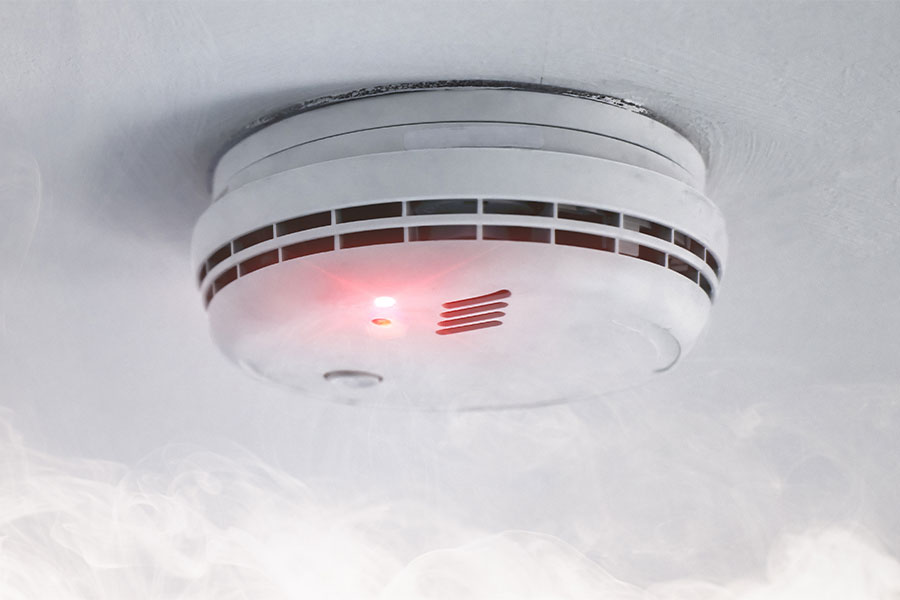
Few household sounds are more persistent than a smoke detector chirping in the middle of the night. It is loud enough to wake the entire house, spaced just far enough apart to be impossible to ignore, and almost always happening at the least convenient hour. Most homeowners respond by pulling the unit down or removing the battery, which stops the noise but leaves the home unprotected and does nothing to address what triggered the alarm in the first place.
In our service calls throughout Providence, we hear this complaint constantly, and the underlying cause is rarely what homeowners assume. A chirping detector is a diagnostic signal. It is telling you something specific about the device, the circuit behind it, or the conditions in the room, and the correct response depends entirely on which of those it is.
This guide walks through the most common reasons smoke detectors beep in Providence homes, what each pattern of sound actually indicates, and how the age and wiring of a property change the way the problem should be handled.
Our electrical services in Providence, RI include smoke detector diagnostics, replacement, and hardwired system upgrades for homeowners who want the issue resolved correctly rather than silenced temporarily.
1. Low or Failing Battery Power
The most frequent cause is also the simplest. Nearly every smoke detector, including hardwired models, contains a battery. In a battery-only unit, that battery is the sole power source. In a hardwired unit, it serves as backup power during an outage. When voltage drops below the threshold the device needs to operate reliably, the detector emits a short chirp roughly every thirty to sixty seconds until the battery is replaced.
What surprises many homeowners is that low-battery chirping tends to cluster seasonally. Battery chemistry is temperature sensitive, and a battery sitting at the edge of its usable life will often cross that threshold when the temperature in the home drops. Providence winters produce exactly those conditions, which is why calls about chirping detectors spike during the first sustained cold stretch of the season.
Signals that point to a battery-related chirp:
- A consistent single chirp at regular intervals, unchanged by time of day or activity in the room
- The sound moves with the unit, meaning the chirp continues if the detector is relocated
- Onset following a temperature drop, particularly in unheated hallways, stairwells, and finished attic spaces
- Multiple detectors chirping within weeks of each other, which usually means the batteries were all installed at the same time
In a home with hardwired, interconnected detectors mounted on high ceilings or stairwell landings, battery service is worth folding into a broader professional inspection rather than handling piecemeal on a ladder.
2. The Detector Has Reached the End of Its Service Life
Smoke detectors do not last indefinitely. The sensing components inside degrade over roughly a decade, and manufacturers build in an end-of-life signal that activates once the device passes that mark. This chirp is easy to confuse with a low battery, and homeowners frequently spend weeks cycling through fresh batteries on a unit that has simply expired.
Working in homes across Providence, from the triple-deckers off Broadway to renovated properties on College Hill, we routinely find detectors well past their useful life. Manufacture dates are printed on the back of the housing, out of sight, and there is no visible indicator on the face of the unit that the device is no longer reliable. A detector that looks perfectly clean on the ceiling may have stopped sensing accurately years ago.
An expired detector is a more serious problem than an annoying one. The device continues to draw power and continues to look functional, but its ability to detect smoke has quietly diminished. Replacement is not optional at that stage, and in homes with interconnected systems, mixing new and expired units across the same circuit can create communication faults between devices.
3. Dust, Debris, and Insect Intrusion in the Sensing Chamber
Smoke detectors work by monitoring a small internal chamber for particles. Anything that enters that chamber and scatters light the way smoke does can trigger either a chirp or a full alarm. Dust is the usual culprit, along with construction debris, cooking residue, and small insects that find their way inside through the vents.
This cause shows up predictably after renovation work. Providence has an enormous amount of ongoing residential rehab, and sanding, demolition, and drywall work push fine particulate through the entire home. Detectors in adjacent rooms often begin behaving erratically days after the work is finished, once the dust has fully settled into the housing.
Conditions that commonly introduce contamination:
- Interior renovation or refinishing work, especially plaster repair, drywall sanding, and floor refinishing
- Detectors mounted close to kitchens, where cooking oils accumulate as a film inside the chamber
- Units near forced-air supply registers, which push dust directly across the sensor
- Seasonal insect activity, particularly in attics, basements, and enclosed porches during warmer months
Cleaning a sensing chamber is more delicate than it appears, and aggressive attempts to clear it can damage the sensor or dislodge internal components. When contamination is recurring rather than isolated, it usually points to a placement problem that should be corrected rather than repeated.
4. Humidity, Steam, and Temperature Swings
Rhode Island’s coastal climate puts real strain on smoke detectors. Humid summers, damp shoulder seasons, and the sharp indoor temperature swings that come with older heating systems all affect how these devices behave. High humidity allows moisture to condense inside the sensing chamber, where the detector interprets suspended water droplets much the same way it interprets smoke particles.
Bathroom steam is the most common version of this problem. A detector positioned just outside a bathroom door, or in a hallway with poor air circulation, will chirp or alarm every time someone showers. Homeowners near the water in Fox Point and along the Blackstone Boulevard corridor deal with elevated ambient humidity for much of the year, which compounds the issue.
Based on what we see in Providence properties, moisture-related nuisance alarms are almost always a placement issue rather than a defect. The detector is doing exactly what it was designed to do. It is simply installed somewhere that guarantees repeated false triggers. Relocating the unit a few feet, changing the sensor type for that specific location, or improving ventilation in the space resolves the problem permanently, while replacing the detector in the same spot resolves nothing.
5. Wiring and Power Supply Problems on Hardwired Systems
The final cause is the one homeowners can least afford to ignore. Hardwired detectors are connected to a branch circuit, and in most modern installations they are also interconnected so that all units sound together. That wiring is a point of failure in its own right. Loose connections in the ceiling box, a failing circuit, voltage fluctuation, or corrosion at a wire nut can all produce chirping, intermittent alarms, or units that sound in sequence for no apparent reason.
Providence’s older housing stock complicates this considerably. Many homes have had detectors added to circuits that were never designed with that load in mind, or tied into wiring that predates modern grounding requirements. Our electrical repairs in North Providence, RI team regularly traces detector faults back to the circuit rather than the device, and the repair required has nothing to do with the detector itself.
Wiring-related indicators worth taking seriously:
- Chirping or alarms that occur simultaneously across multiple units with no smoke or steam present
- Detectors that behave differently when a specific appliance or circuit is in use
- Alarms that follow a power outage or utility fluctuation and do not reset normally
- Persistent faults after all units on the circuit have been replaced
In homes still operating on legacy wiring, a knob and tube wiring replacement is often the real solution. Ungrounded legacy circuits cannot support a properly interconnected detector system, and adding modern devices to that wiring produces exactly the intermittent behavior homeowners find so difficult to diagnose.
How Panel Capacity Affects Detector Reliability
Smoke detectors draw very little power, so the connection between the panel and detector performance is easy to overlook. The relationship is real, though. Detectors are typically tied to a general lighting or receptacle circuit, and when that circuit is overloaded or the panel is undersized for the home’s current demands, the voltage reaching the device becomes inconsistent.
Inconsistent voltage does not usually stop a detector from working. It causes it to behave unpredictably, chirping intermittently, dropping out of the interconnected chain, or falling back to battery power without any obvious trigger. Homeowners interpret that as a faulty device and replace it, only to see the same pattern return with the new unit.
An electrical panel repair and upgrade addresses the root of that instability. Bringing the panel to adequate capacity, correcting double-tapped breakers, and rebalancing load across circuits gives every device in the home, including life safety equipment, the stable power supply it depends on.
Deciding How to Respond When a Detector Beeps
Not every chirp requires a service call, but the decision framework matters more than the individual cause. The question to work through is whether the behavior is isolated or systemic, and whether it resolves permanently or returns.
A single unit chirping on a predictable interval, in a home where the detectors are relatively new, is typically a device-level issue and the least concerning scenario. Behavior that involves more than one unit, follows electrical events in the home, or returns after the device has already been replaced is not a device-level issue at all. That pattern points to the circuit, and no amount of detector swapping will resolve it.
The threshold for professional evaluation is straightforward. If the same problem has come back more than once, if multiple detectors are involved, if the home is on legacy wiring, or if the detectors are hardwired and their age is unknown, the system needs to be assessed as a system. Life safety equipment is not an area where a temporary fix is an acceptable outcome, and a home with detectors that have been disabled or removed to stop the noise is operating without protection entirely.
Keeping Your Providence Home Protected
A beeping smoke detector is worth treating as useful information rather than a nuisance. It points toward battery condition, device age, environmental factors, or the wiring behind the ceiling, and each of those has a different and specific resolution. The homes where this becomes a recurring frustration are almost always the ones where the underlying condition was never identified.
At Premier Electrical Services and Generators, we evaluate smoke detector issues in the context of the whole electrical system, because that is usually where the answer is. Our licensed electricians assess device age and placement, test the circuits behind hardwired units, and correct the conditions causing repeat faults rather than replacing hardware and hoping the problem stays away. Every Providence home we work in gets the same standard of care, whether the job is a single detector or a full system upgrade.
If a detector in your home has been chirping, alarming without cause, or behaving unpredictably, contact our team today to schedule an inspection and get a clear answer on what is actually causing it.