
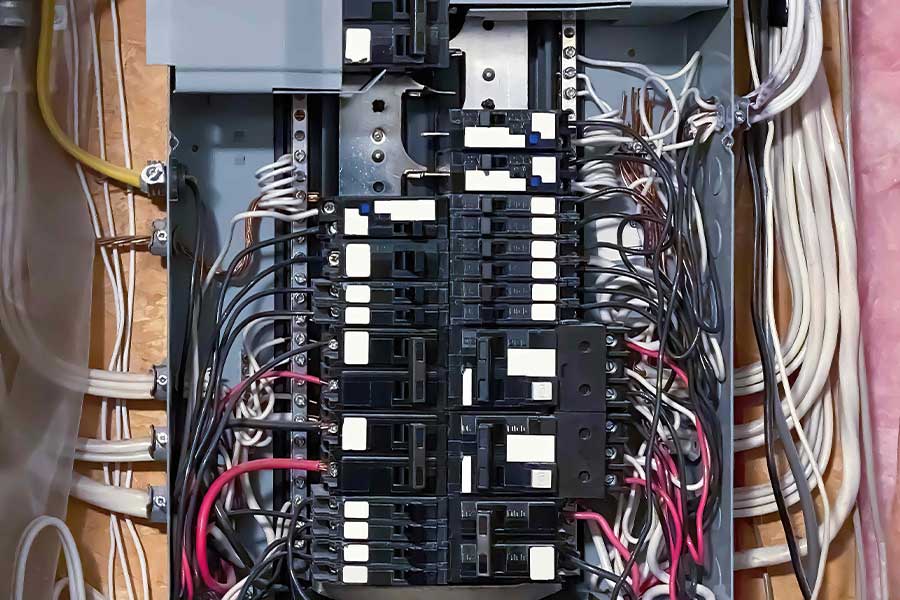
There is a particular kind of frustration that comes with a breaker that only trips in the winter. The house is fine all summer. Then the first real cold stretch arrives, the heat starts running on a regular cycle, and suddenly a section of the home goes dark every few days. Homeowners reset the breaker, the heat runs for a while, and the cycle repeats.
In our service calls throughout Cranston, this is one of the most common winter complaints we respond to, and it is almost never random. A breaker that trips specifically when heating equipment engages is responding to a measurable condition on that circuit. The panel is doing its job. The question is what it is protecting the home from.
This guide covers what actually happens electrically when the heat kicks on, the four conditions that most often cause a trip in Cranston homes, and how to tell the difference between an inconvenience and a warning sign that needs attention before the season gets colder.
Our electrical services in Cranston, RI include diagnostic work on heating circuits, panel evaluation, and the repairs needed to keep a home’s electrical system stable through a New England winter.
What Actually Happens When Your Heat Engages
Understanding the trip requires understanding the moment it occurs. Heating equipment does not draw a steady, predictable amount of current from the moment it turns on. Motors, blowers, compressors, and resistance heating elements all pull a surge of current at startup that is significantly higher than what they consume once running. That initial surge, known as inrush current, can be several times the equipment’s normal operating draw.
A circuit that handles the running load without issue can still be pushed past its limit during those first seconds. This is why the trip happens at the exact moment the heat engages rather than after it has been running for an hour, and why the problem often appears only in winter, when heating cycles are frequent enough for the pattern to become obvious.
The New England climate compounds this. During the sustained cold snaps that settle over Cranston in January and February, heating equipment cycles far more frequently and runs for longer intervals. A marginal circuit that survived a mild December will begin failing consistently once the demand becomes constant.
1. The Circuit Is Carrying More Load Than It Was Designed For
The most common cause is straightforward overload. Heating equipment is placed on a circuit that is also serving outlets, lighting, or appliances, and the combined demand exceeds what the wiring and breaker are rated to carry. The breaker trips because the total current on that circuit crossed its threshold.
This happens more often than homeowners expect, particularly in homes that have been renovated over time. Working in homes across Cranston, from the older properties around Edgewood and Pawtuxet Village to the postwar neighborhoods near Garden City, we regularly find heating equipment sharing a circuit with a home office, a basement workshop, or a kitchen appliance that was added years after the original wiring was installed.
Common overload scenarios we encounter:
- Space heaters or supplemental heat on general-purpose circuits, which are among the highest-draw devices in any home
- Baseboard heat tied into circuits also serving bedroom outlets, where phone chargers, lamps, and electronics add up
- Basement or garage heating on the same circuit as freezers, dehumidifiers, or power tools
- Renovated spaces where new outlets were extended from existing circuits rather than run from the panel
Electric baseboard systems deserve particular attention here, since they draw heavily and continuously while operating. Our electric baseboard heater installation and repair work frequently involves correcting exactly this problem, moving heating loads onto properly rated dedicated circuits so the equipment has the capacity it requires.
2. The Breaker Itself Has Worn Out
Breakers are mechanical devices with a finite service life. Every trip and reset causes a small amount of wear on the internal components, and over decades of use the thermal element inside can weaken to the point where it responds to normal current as though it were an overload. When that happens, the breaker begins tripping at a lower threshold than its rating suggests.
The pattern is recognizable. A breaker that has served a circuit reliably for years starts tripping more and more easily, eventually reaching a point where it will not hold at all under a load it handled without complaint the previous winter. The circuit has not changed. The breaker has degraded.
This is not a condition to work around by simply installing a higher-rated breaker in its place. The breaker rating is matched to the wire size behind it, and increasing the rating allows the wiring to carry more current than its insulation was designed to handle safely. A worn breaker gets replaced with an identical rating, not a larger one, and the reason it failed is worth understanding before the replacement goes in.
3. A Fault in the Heating Equipment or Its Wiring
A trip that occurs the instant heat engages, rather than after a period of running, often points to a fault rather than an overload. Short circuits and ground faults produce an immediate, dramatic current spike that a breaker responds to within a fraction of a second. If the breaker trips the moment the thermostat calls for heat and will not reset while the equipment is connected, a fault is the likely explanation.
Faults develop in heating systems for reasons that build slowly. Insulation on conductors inside a baseboard unit degrades from years of heat cycling. Connections at a junction box loosen through thermal expansion and contraction. Moisture reaches a component in a basement or crawl space and creates a path to ground where none should exist. Rodent damage to wiring in attics and wall cavities is another cause we find with some regularity in older Cranston properties.
Indicators that point toward a fault rather than an overload:
- The breaker trips immediately on startup, not after minutes or hours of operation
- The breaker will not reset while the heating equipment remains connected to the circuit
- A burning or scorched odor near the equipment, a junction box, or the panel
- Visible discoloration, melting, or damage at connections, terminals, or the equipment housing
- The trip is accompanied by a distinct sound, such as a snap or pop at the panel or the equipment
A fault is not a wait-and-see condition. Our electrical repairs team traces these conditions to their source, because a fault that trips a breaker today is generating heat somewhere in the system that a reset does nothing to address.
4. The Panel No Longer Matches the Home’s Demands
The fourth cause sits behind all the others. Many Cranston homes are operating on electrical service that was sized for a household with a fraction of today’s demands. A panel installed decades ago was never planned around electric heat, central air, EV charging, home offices, and the number of appliances a modern household runs simultaneously.
When total demand approaches the limits of the service, the effects show up first on the circuits carrying the heaviest loads, and in winter that means the heating circuits. The system is not failing at any single point. It is simply being asked to deliver more than it was built to supply, and the breakers protecting the most demanding circuits are the ones that give way first.
Panel condition matters as much as capacity. Double-tapped breakers where two circuits share a slot, loose connections at the bus bar, corrosion from moisture exposure, and uneven load distribution across the panel’s two legs all contribute to instability that becomes most visible under winter heating demand. An electrical panel repair and upgrade resolves these conditions at their source, giving the home adequate capacity and a properly balanced distribution of circuits.
Based on what we see in Cranston properties, homeowners often spend two or three winters chasing individual circuit problems before the panel is evaluated as a whole. The individual repairs are not wrong. They are simply addressing symptoms of a system that has outgrown its service.
Reading the Pattern in Your Own Home
The useful question is not which of these four causes applies, since that requires testing to determine. It is whether the behavior you are seeing suggests something manageable or something urgent, and there are a few reliable ways to read that.
Timing tells you a great deal. A trip that happens after the heat has been running, especially when other things are drawing power at the same time, generally indicates a capacity or load problem. A trip that happens the instant the equipment engages, every time, points toward a fault or a failing breaker. A breaker that trips more easily this year than last is degrading regardless of what is on the circuit.
Frequency matters just as much. An isolated trip during an unusual moment of demand is worth noting but not alarming. A trip that recurs on a predictable schedule is a system telling you it is operating at its limit, and that limit will not improve as the winter gets colder and the heat runs harder.
The conditions that call for professional evaluation without delay are the ones involving heat, odor, or damage. A warm breaker, a scorched smell, discoloration at an outlet or panel, or a breaker that refuses to reset are all indications that current is going somewhere it should not. Repeated resetting in those circumstances removes the protection the breaker is providing without removing the condition it is responding to.
Keeping Your Cranston Home Warm and Safe This Winter
A breaker that trips when the heat kicks on is protective equipment working correctly under conditions that need attention. Whether the cause is load, a worn breaker, a fault, or a service that no longer fits the home, the answer comes from testing the circuit and evaluating the system, not from resetting and hoping the cold breaks first.
At Premier Electrical Services and Generators, we diagnose winter breaker problems by looking at the whole picture, measuring actual load on the affected circuits, testing breaker performance, inspecting heating equipment connections, and assessing whether the panel and service can support how the household actually uses power. Our licensed electricians work throughout Cranston and the surrounding communities, and we approach every heating circuit issue with the understanding that reliable heat in a Rhode Island winter is not a convenience.
If your breaker has been tripping when the heat engages, schedule your service today and get a clear diagnosis before the coldest part of the season arrives.