
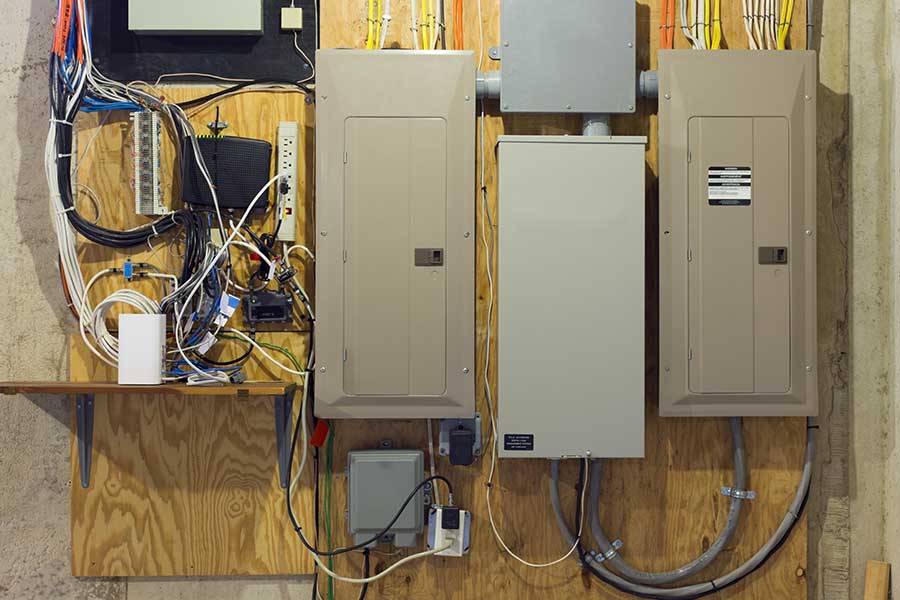
Most homeowners go years without paying attention to their electrical panel. It sits in a basement, a utility closet, or a garage wall, doing its job quietly. So when it starts making noise, the sound is unfamiliar enough that people are unsure whether it matters. Some assume it is normal. Others notice it, mean to look into it, and forget until it gets louder.
A buzzing panel is not something to file away for later. In our service calls throughout Providence, panel noise is one of the few symptoms that reliably indicates an active problem rather than a developing one. Electricity moving correctly through a properly functioning panel is close to silent. Audible buzzing means current is encountering resistance, arcing across a gap, or vibrating a component that should be held firmly in place.
This guide explains what panel noise actually indicates, the five conditions that most often produce it in Providence homes, and how to judge the urgency of what you are hearing.
Our electrical services in Providence, RI include panel diagnostics and repair for homeowners who want a definitive answer about what their panel is doing and why.
What Panel Noise Actually Tells You
Sound in an electrical panel comes from one of two sources. The first is mechanical vibration, where a component that should be tightly seated is loose enough to move slightly as alternating current cycles through it sixty times per second. The second is arcing, where current jumps a small gap between conductors instead of flowing through a solid connection.
The distinction matters because these two conditions carry different levels of risk, though neither is acceptable long term. Vibration is a sign that something is not properly secured. Arcing produces intense, localized heat capable of igniting surrounding materials, and it is the mechanism behind a significant share of residential electrical fires.
There is a narrow exception. Some panels produce a faint, steady hum from the transformer effect within the equipment, audible only when standing close in a quiet room. What homeowners describe as buzzing is different. It is audible from across the room, it may be intermittent, and it often changes in intensity when appliances cycle on. That is not normal.
1. Loose Connections at Breakers or the Bus Bar
The most frequent cause of panel buzzing is a connection that has worked its way loose. Every breaker in a panel clips onto a bus bar, and every circuit conductor terminates at a screw terminal. Those connections carry substantial current, and current generates heat. Heat causes metal to expand and contract, and over years of daily cycling, that repeated movement gradually loosens what was tight at installation.
Once a connection loosens, current has to cross a small gap or an imperfect contact point. That produces both the vibration and the arcing that a homeowner hears as buzzing. It also produces heat at exactly the spot where the connection has failed, which is why loose connections are among the most common origins of panel fires.
Providence’s older housing stock makes this especially relevant. Working in homes across Providence, from the multi-family properties in Olneyville and Silver Lake to the single-family homes around Wayland Square, we routinely open panels that have not been serviced since installation. Connections that were torqued correctly forty years ago have had four decades of thermal cycling to work loose.
2. A Failing Breaker That Is No Longer Tripping Correctly
A breaker is supposed to be fail-safe. When current on a circuit exceeds what the wiring can safely carry, the breaker interrupts the flow. A breaker that has degraded internally may continue to pass current while losing the ability to trip, and in some cases the failure announces itself with a buzz.
This is the more dangerous version of panel noise. A breaker that buzzes under load, feels warm to the touch, or has visible discoloration around its face is not simply noisy. It is a protective device that may no longer protect. The circuit behind it continues operating with no functioning safeguard against overload or short circuit.
Signs that point toward breaker failure rather than a loose connection:
- The buzzing traces to one specific breaker rather than the panel generally
- The noise increases when the circuit that breaker serves is under load
- The breaker feels warm or hot relative to the others in the panel
- Discoloration, melting, or scorch marks on or around the breaker face
- The breaker has a history of not tripping during conditions that should have caused it to
An electrical panel repair and upgrade in North Providence, RI frequently begins with exactly this finding, because a breaker that has failed in this way often indicates a panel where the remaining breakers are the same age and approaching the same condition.
3. The Panel Is Operating at or Beyond Its Capacity
Panel noise sometimes reflects demand rather than damage. When a home draws close to the limits of its electrical service, every connection in the panel carries current near its rated maximum. Components run hotter, marginal connections become audible, and the panel begins producing noise during periods of heavy use that goes quiet when demand drops.
The pattern is what identifies this cause. Buzzing that appears on winter evenings when heat, lighting, cooking, and electronics are all running simultaneously, then disappears overnight, pointing to a load issue rather than a hardware failure. The panel is not broken. It is being asked to deliver more than it was designed to supply.
This has become considerably more common as household electrical demand has grown. A service sized for a home in 1965 was never planned around central air conditioning, EV charging, multiple home offices, induction cooking, and the sheer volume of connected devices in a modern household. Based on what we see in Providence properties, capacity-related panel noise is often the first clear signal that a service upgrade is overdue.
4. Moisture, Corrosion, and Physical Damage Inside the Enclosure
Panels are not sealed environments, and the conditions where they are typically installed are not always kind to them. Basements in Providence homes are frequently damp, and panels mounted in unfinished basements, garages, or exterior enclosures are exposed to humidity, condensation, and occasionally direct water intrusion.
Moisture corrodes the metal surfaces where connections are made. Corrosion increases resistance at those contact points, and increased resistance produces heat and arcing in the same way a loose connection does. Corrosion is often worse than a loose connection because it degrades the contact surface itself, so simply retightening does not restore a solid connection.
Conditions that introduce moisture and damage to a panel:
- Water intrusion around the service entrance where conductors enter the enclosure
- Persistent basement humidity that produces condensation on cool metal surfaces
- Roof or plumbing leaks above the panel location, which may go unnoticed for extended periods
- Rust or white powdery residue visible on the enclosure interior, breakers, or bus bar
- Pest intrusion, where nesting material and rodent damage compromise insulation inside the enclosure
Our electrical repairs team addresses these conditions as part of a full panel evaluation, because corrosion visible at one point in an enclosure almost always indicates the same process occurring at connections that are not immediately visible.
5. Service Entrance and Utility Side Problems
Not every source of panel noise originates inside the panel. The service entrance, where utility conductors reach the home through the weatherhead, meter base, and main service conductors, is a common origin of buzzing that appears to be coming from the panel itself.
Loose connections at the meter base, deteriorated insulation on service entrance conductors, or a compromised neutral connection between the home and the utility all produce noise and instability that presents at the panel. A failing neutral connection is particularly serious, since it can cause voltage to distribute unevenly across the home’s circuits, damaging appliances and electronics while the panel hums or buzzes continuously.
Rhode Island’s weather contributes here. Coastal humidity, salt in the air, freeze and thaw cycles, and the wind loading that overhead service conductors experience during winter storms all accelerate wear at these connection points. Service entrance issues also require coordination with the utility, since portions of that equipment fall outside the homeowner’s responsibility, which is another reason this is not a condition to diagnose informally.
Panel-level protection is worth considering alongside any service entrance work. A whole-house surge protector installation defends every circuit in the home against the voltage events that unstable service conditions and utility fluctuations can send through the system.
Judging How Quickly You Need to Act
Panel noise sits on a spectrum, and knowing where a particular situation falls determines the appropriate response. The variables that matter are what the noise sounds like, whether it is constant or tied to load, and whether it comes with any other symptom.
Noise on its own, faint and consistent, in a panel with no other indications of trouble, warrants a professional evaluation on a normal timeline. Noise that correlates with heavy household demand suggests a capacity question worth addressing before the next winter or summer peak. Noise that has appeared recently or grown louder over weeks indicates a condition that is actively progressing.
Noise accompanied by heat, smell, or visible damage is a different category entirely. A warm panel cover, a burning or acrid odor near the enclosure, scorch marks, flickering throughout the home, or a crackling and popping sound rather than a steady buzz all indicate arcing that is already occurring. These conditions call for immediate professional attention, and the panel should not be opened, worked on, or investigated by anyone other than a licensed electrician. Panel interiors contain energized components that remain live even when the main breaker is off.
Getting a Clear Answer About Your Providence Panel
A buzzing panel is one of the few electrical symptoms with essentially no benign explanation. Whether the source is a loose connection, a failing breaker, demand exceeding capacity, corrosion, or an issue at the service entrance, each of those conditions produces heat somewhere in a system that carries every amp of power your household uses. None of them resolve without intervention, and all of them get worse.
At Premier Electrical Services and Generators, we treat panel noise as a priority diagnostic. Our licensed electricians perform thermal evaluation, check torque on connections throughout the enclosure, test breaker performance under load, inspect the service entrance, and assess whether the panel’s capacity fits how the home actually operates. We give homeowners a direct account of what we find and what it will take to correct it, whether that is a targeted repair or a full replacement.
If your panel has been making noise, however faint, contact our team today to schedule an inspection and find out exactly what your system is doing.